· ReadyStack
Worked example
Real numbers from this tool, line by line.
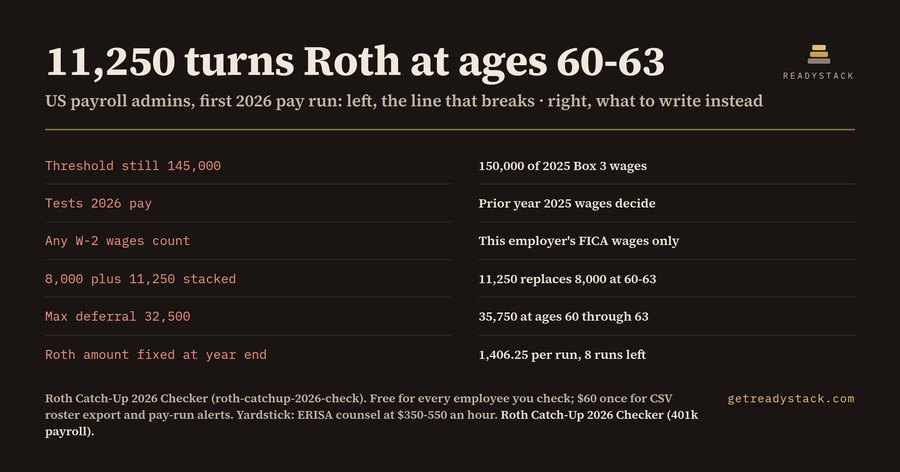
US payroll administrators: an employee who turns 61 in 2026 and earned 158,000 in 2025 FICA wages has 11,250 of catch-up that must be coded Roth, which is 1,406.25 on each of the eight pay runs left. Not part of it. All of it.
That is SECURE 2.0 section 603 landing on a payroll deduction code. The transition period that let plans keep running catch-up pre-tax ran out at the end of 2025. From the first 2026 pay run, any participant age 50 or older whose prior-year FICA wages from the sponsoring employer exceeded the indexed threshold can only make catch-up contributions on a Roth basis.
The threshold moved: IRS Notice 2025-67 raised the Roth catch-up wage figure to 150,000, measured on 2025 wages, for 2026 coding. Guidance still in circulation, and much of what an AI assistant tells a benefits manager who asks, still says 145,000. Ten employees between those two numbers is ten wrong deduction codes.
Three things go wrong most often, none of them arithmetic.
The first is which year. The test looks at the prior calendar year, not the one being paid. An employee earning 190,000 in 2026 who earned 138,000 in 2025 is not subject for 2026 catch-up, and neither is a new hire with no 2025 wages from this employer.
The second is which wages. The figure is FICA wages from the plan's sponsoring employer, the amount in Box 3 of the 2025 W-2. Not Box 1. Not combined wages across two employers in a controlled group filing separate W-2s. Box 3 is capped at the Social Security wage base, and a partner with self-employment income carries no FICA wages at all.
The third is the age 60 to 63 rule, and it produces real dollar errors. The super catch-up for participants who turn 60, 61, 62 or 63 during 2026 is 11,250. It replaces the standard 8,000 catch-up. It does not stack on top of it. Elect both and 3,250 is above the limit and comes back out as a corrective distribution. The maximum elective deferral for that age band in 2026 is 24,500 plus 11,250, which is 35,750, not 24,500 plus 8,000 plus 11,250.
The checker runs one employee at a time and returns the verdict as a sentence. Feed it 158,000 of 2025 wages, age 61, a plan with a designated Roth source, an 11,250 election and eight pay runs left, and it returns: Roth-only catch-up from the first 2026 payroll, limit 11,250, maximum deferral 35,750, 11,250 to code Roth, 1,406.25 per run. Drop the wages to 149,000 and the verdict flips to pre-tax being fine and the Roth amount drops to zero. Change the age to 55 and the limit becomes 8,000, the maximum deferral 32,500, and 3,250 of that election shows up as over the limit.
The fourth answer is the expensive one. Set the plan to pre-tax deferrals only and the tool returns 11,250 blocked: the Roth requirement applies and the plan has nowhere to put it, so the employee cannot make catch-up at all. That is a plan document problem surfacing in a payroll run, better found in September than in a W-2 reconciliation.
Miscoding is not free to unwind: a W-2c for the employee, rework at the payroll vendor, and, when the fix reaches the IRS Voluntary Correction Program, a user fee of 1,500 to 3,500 by plan assets. ERISA counsel reviewing catch-up coding bills 350 to 550 an hour.
The web page and the extension run the same code, and every calculation is free and unlimited, with no key and no run limit. The 60 dollar key changes the axis rather than the answer: it exports the roster you checked to a CSV the payroll vendor can map to the designated Roth source, and it sets alerts before each 2026 pay run so a mid-year raise crossing 150,000 is not missed.
Questions people ask
What does this extension actually do?
It answers one payroll question: for a given employee, must their 2026 401(k) catch-up be coded Roth? It applies the 150,000 prior-year FICA wage test, picks the right 2026 catch-up limit for their age, and returns the dollar amount to code Roth and the amount per remaining pay run.
Who is this for?
US payroll administrators, 401(k) plan sponsors and benefits managers who set deferral codes before a pay run. It is built for the person mapping employees to a designated Roth source in ADP, Paychex, Workday or Gusto, not for the employee choosing a contribution rate.
Why not just use a free retirement calculator?
Free calculators size a contribution; they do not decide the Roth-or-pre-tax coding question. That turns on 2025 W-2 Box 3 wages from the sponsoring employer alone, on whether the plan has a designated Roth source, and on the age 60-63 rule that replaces rather than adds to the 8,000 catch-up.
What is free and what needs the key?
Every calculation is free and unlimited, with no watermark and no run limit: verdict, limit, Roth amount, per-pay-run split and over-limit warning. The 60 dollar key adds two things on a different axis, taking the work with you and repeating it: CSV export of the checked roster and alerts before each 2026 pay run.
What would this cost handled by a person?
ERISA counsel reviewing catch-up payroll coding bills roughly 350 to 550 an hour, and a single-employee miscoding that reaches correction adds an IRS Voluntary Correction Program user fee of 1,500 to 3,500 depending on plan assets, before the W-2c and the payroll vendor's rework.
Ask about this tool
One question, answered by the person who built it. Your email only if you want the answer sent.